
2 October 2026•5 min read
Why Saudi Builders Choose Aluminum Entrance Doors
Practical guidance from Ramz Al Badran's factory in Riyadh on aluminum doors Saudi Arabia — what to specify, what it costs and how it performs in the Saudi climate.
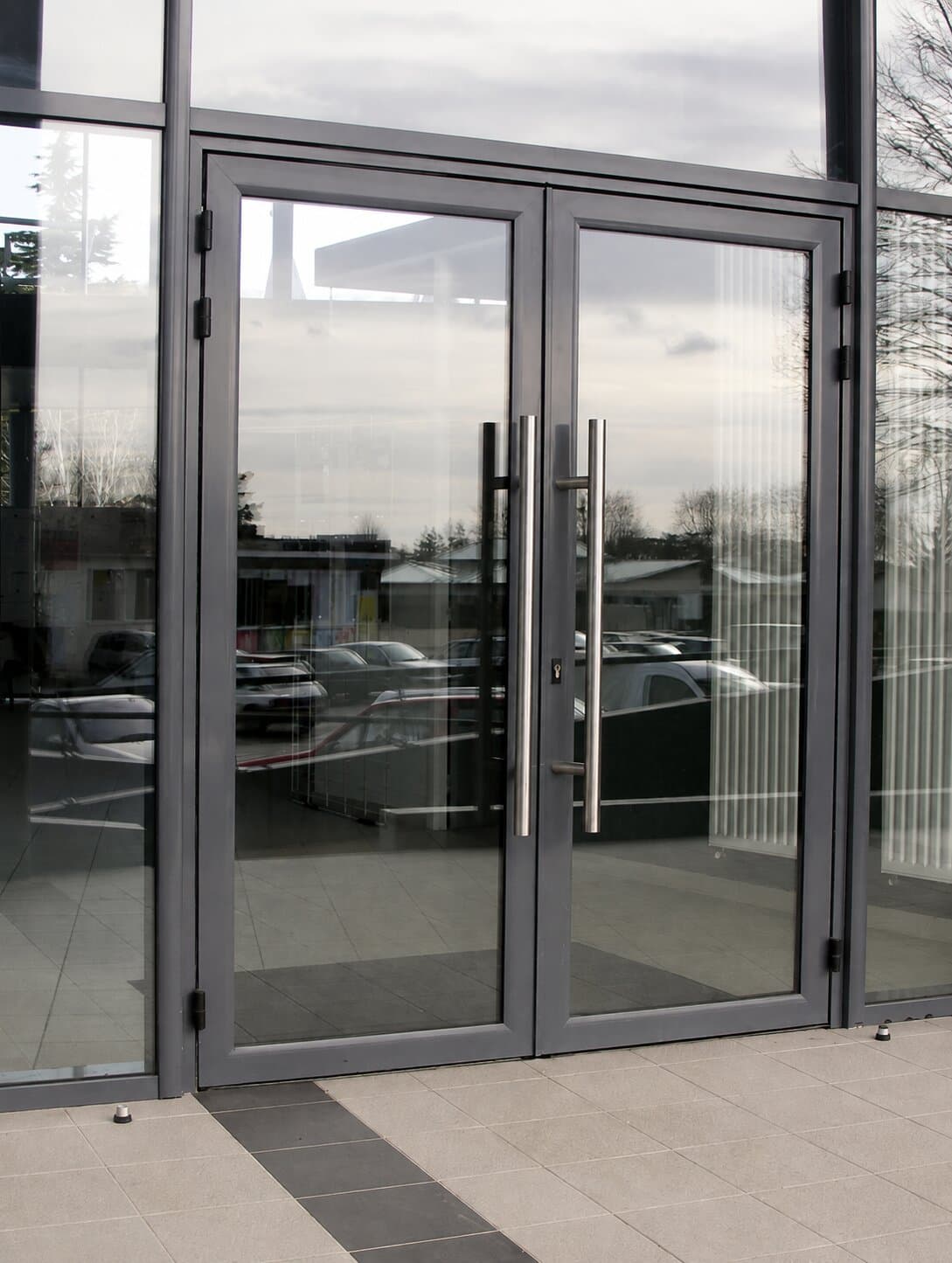
The One Opening That Gets Used Every Day
An entrance door is the component every visitor touches, every courier uses, and every contractor is blamed for when it starts to stick. In a Saudi building it also carries the hardest duty cycle on site: dozens or hundreds of operations a day under direct sun, with fine dust working its way into every moving joint. Aluminum became the default material for this job for a simple reason — it holds its geometry, its finish and its operation after years of that punishment, while heavier timber and steel alternatives lose the fight one hinge at a time.
Four Properties Builders Actually Care About
Weight comes first. An aluminum door leaf weighs roughly a third of a steel leaf of the same size, which makes it easier to handle and hang on site and takes years of stress off hinges, pivots and automatic operators. Second is corrosion resistance: extruded 6063 alloy with T5 or T6 temper forms a natural oxide layer, so a scratch from a trolley or a ladder does not turn into a rust streak across the facade — a decisive advantage in coastal cities where salt air attacks steel fixings within a season.
Third is finish life. Factory powder coating or anodizing keeps its color and gloss through years of ultraviolet exposure that would bleach a poorly painted surface within two summers. Fourth is dimensional accuracy: profiles are cut and machined to tight tolerances in a controlled workshop, so doors arrive ready to hang instead of needing on-site trimming. For a contractor protecting a handover date, that predictability is worth as much as any technical figure.
Specifying for Riyadh Heat, UV and Shamal Dust
Three environmental loads decide whether an entrance door still works well in year ten. Heat is met with a thermal break: a polyamide barrier between the outer and inner faces of the profile that interrupts conduction, lowering cooling load in summer and cutting condensation on cold mornings. Ultraviolet exposure is met with coating quality — 60 to 80 microns of powder coating or a properly sealed anodized finish, both of which should carry a written warranty against fading and chalking.
Dust is the load most underestimated in specifications. Fine sand enters through any gap that is not deliberately sealed, so a desert-ready door needs EPDM gaskets around the leaf, brush seals at the jambs, covered or shielded bottom tracks, and drainage slots cut at the factory so that a rare heavy rain never pools in the sill. These parts cost little but they are exactly the items a low quotation removes first.
Glass and Hardware: Where Cheap Doors Fail
Glass is half the door on most modern entrances, and it is the first place an economy quotation hides savings. Entrances facing west or exposed to afternoon sun should use double glazing with a low-E coating on the outer pane, and safety glass — tempered or laminated — wherever people walk through. Single 6 mm clear glass is cheaper and looks correct in the showroom, then turns the lobby into an oven in July and fails the energy section of the building code review.
Hardware decides how the door feels long after the paint is admired. Expect a multipoint lock rather than a single latch on a main entrance, three hinges or a pivot for tall leaves, heavy-duty closers that are adjustable rather than fixed, and named roller or operator brands that can be replaced locally. Ask for the hardware schedule in the quotation — if it is not listed, it has not been selected.
Sliding or Hinged: Matching the Door to the Traffic
Villa entrances almost always work best with a hinged leaf: it seals tightly, carries a multipoint lock, and a tall aluminum leaf stays light enough to open with one hand for decades. Terraces, showrooms and tight corridors point to sliding doors, which need no swing radius and offer a wide clear opening. Ball-bearing rollers running on stainless or nylon tracks tolerate dust far better than sheet-metal slides, and they are the difference between a door that glides in year five and one that is lifted back onto its rail.
Commercial lobbies usually need both: an automatic sliding leaf for the public entrance, with hinged side doors for staff access and after-hours control. Decide the configuration before the header is detailed, because it fixes the structural opening, the threshold detail and the wall space the leaf parks into when open — three items that are expensive to change once the facade is fabricated.
Building Code and Energy Requirements
Entrance doors sit inside the building envelope, so they are part of the energy calculation under the Saudi Building Code's envelope provisions. That is where the thermal break and the glass build-up stop being optional upgrades and start being compliance items — a thermally broken frame with low-E double glazing is the configuration that satisfies both the code reviewer and the client paying the electricity bill.
Commercial exits carry a second layer of requirements covering egress and fire. That means the correct opening direction, panic or push-bar hardware where the occupancy load requires it, doors that swing freely, and fire-rated glazing or an approved door assembly on protected routes. A fabricator who has delivered commercial projects in Riyadh will raise these points at quotation stage, before an inspector raises them on site.
What Aluminum Entrance Doors Cost in 2026
Working ranges from Riyadh fabrication floors: a hinged aluminum entrance door with thermal break, multipoint locking and double glazing typically falls between SAR 2,000 and 3,500 per square meter supplied and installed, so a standard 1.1 by 2.4 meter villa door lands around SAR 5,300 to 9,200. Sliding aluminum doors with good rollers and double glazing run SAR 1,200 to 2,000 per square meter, and automatic operators add SAR 6,000 to 15,000 depending on leaf weight and operator brand.
Four things move the number: the profile system, the coating and its warranty, the glass specification, and whether the price includes a site survey, delivery, installation and removal of the old door. Ask for an itemized quotation and a written fabrication and delivery schedule. In the Saudi summer, a door that arrives two weeks late can push back a handover worth far more than the door.
Factory-Direct Entrance Doors From Ramz Al Badran
Ramz Al Badran manufactures aluminum entrance doors in Riyadh for villas, commercial buildings and government projects across the Kingdom. Because we fabricate what we deliver, every opening is measured on site, produced against a documented specification, inspected before dispatch and installed by our own crews. You deal with the factory that cut the profiles — not a trader passing your order down a chain.
If you are comparing aluminum door suppliers or manufacturers in Riyadh, send us your drawings or opening list. We will return an itemized factory quotation with a fabrication schedule, and you are welcome to visit the production floor to see the profiles, the glazing line and the quality checks before you commit.