
29 September 2026•5 min read
Stainless Steel vs Aluminum Handrails: Which Lasts in KSA?
Practical guidance from Ramz Al Badran's factory in Riyadh on stainless steel handrails Saudi Arabia — what to specify, what it costs and how it performs in the Saudi climate.
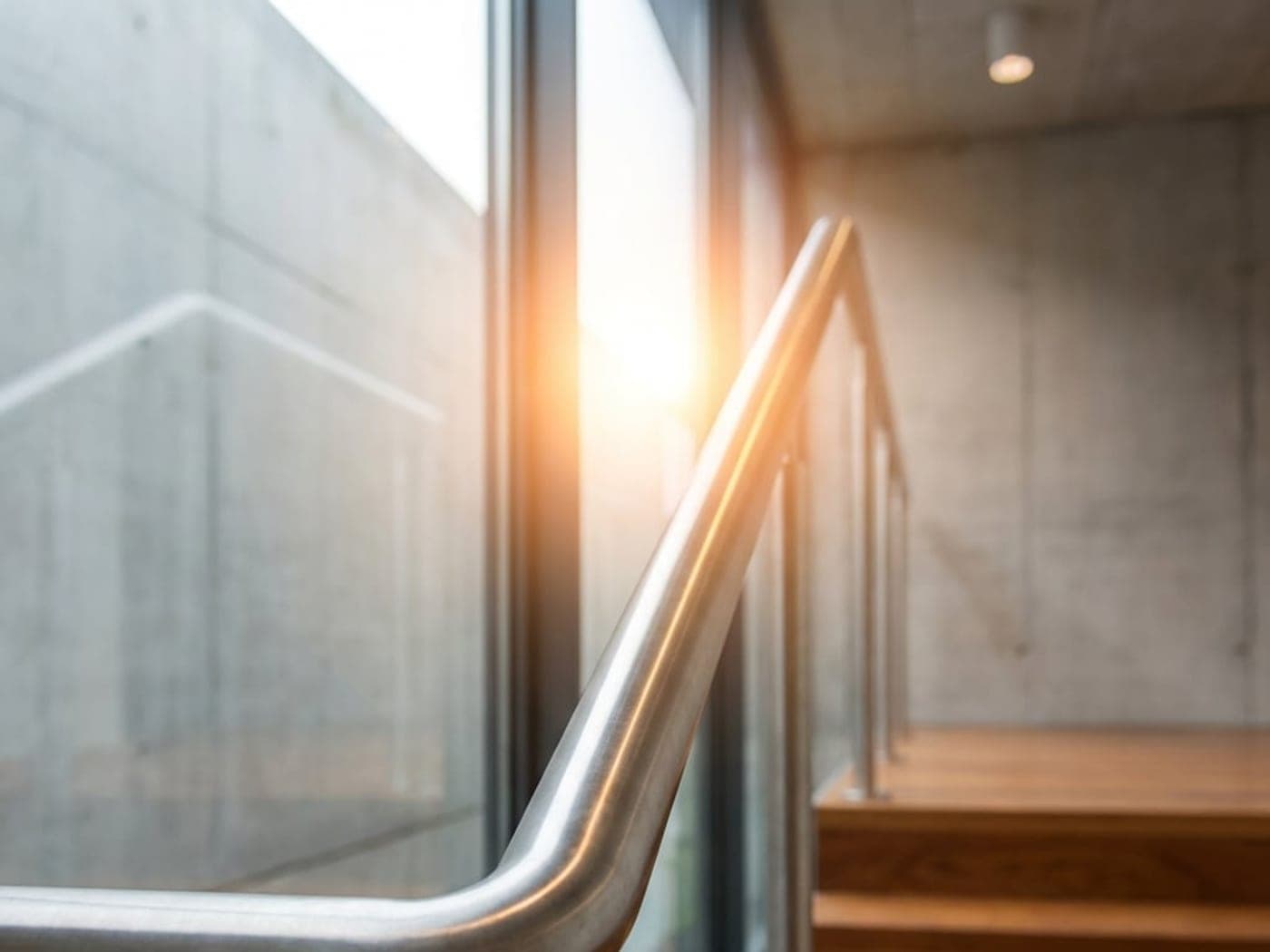
Handrails are the one building element every visitor touches — on the stair, the balcony and the roof edge. In Saudi Arabia they also face relentless sun, abrasive dust and, on the coast, salt-laden air. Choosing between stainless steel and aluminum is really a question of grade, finish and exposure, not brand loyalty. Here is how the two behave in the Kingdom, what they cost in 2026, and which one to specify where.
Why the Saudi Climate Decides
Riyadh is hot, dry and dusty: summer surface temperatures on exposed metal easily pass 60°C, UV radiation is intense, and fine sand acts as a mild abrasive on any coating. Coastal cities such as Jeddah, Dammam and Jubail add airborne chlorides that attack metal even where it never gets wet. A railing that looks perfect in an air-conditioned showroom can show its first rust bleed or chalked finish within two summers if the grade or coating was chosen for the wrong exposure.
That single fact — inland versus coastal — decides more of your specification than any aesthetic preference. Get it right and both materials last decades; get it wrong and neither will.
Stainless Steel: Grades and Reality
Grade 304 is the workhorse for interior stair cores and inland exterior railings; it resists corrosion well and takes a beautiful finish. Grade 316 adds molybdenum and is the correct choice within roughly 10 to 15 km of the coast, where chloride-rich air causes 304 to tea-stain and eventually pit. The price difference is worth it: 316 typically adds 15 to 25 percent to the material, far less than replacing a rusting balustrade in three years.
Wall thickness matters more than polish. Specify 1.5 to 2.0 mm tube for structural rails and posts and no less than 1.2 mm for infill; a thin, mirror-polished tube is weaker and more prone to denting than a satin one of honest gauge. Finish is practical too: brushed satin hides fingerprints and marks, while mirror polish shows every touch and costs more to maintain.
Finally, welding quality decides service life. Heat-tinted welds that are not dressed, pickled and passivated are where rust always starts first. Ask your fabricator how they finish welds — that answer tells you more than any brochure.
Aluminum Handrails: Light, Finished, Forgiving
Aluminum railings are extruded from 6063 alloy, usually in T5 or T6 temper, then anodized or powder-coated. They never rust: a natural oxide layer forms instantly and re-forms if scratched. Weight is the headline advantage — aluminium is roughly one third the density of steel — which eases handling, reduces loads on balconies and simplifies fixing to walls and slabs not designed for heavy steel.
The trade-offs are stiffness and hardness. Aluminum is softer, so it dents and scratches more easily, and it flexes more under load, which is why an aluminum guard needs chunkier profiles than steel to reach the same rigidity. Anodizing (15 to 25 micron) gives a metallic look that shrugs off UV, while powder coating (60 to 80 micron) allows any colour and better resists chalking in strong sun. Many elegant systems pair a steel core with aluminum cladding — the strength of steel with the finish of aluminum.
Head-to-Head
Corrosion: 316 stainless is the best all-rounder, especially at the coast; 304 is excellent inland; anodized or powder-coated aluminum resists both and cannot rust through. Strength and stiffness: steel wins section for section, so aluminum systems need larger profiles for the same span. Weight: aluminum is about a third the density, easier to handle and kinder to the structure. Maintenance: all three are low-maintenance, but stainless needs occasional cleaning to avoid tea-staining, and powder coat can be repainted if chipped.
Cost at the counter: aluminum profiles usually cost less per linear metre than stainless, but the gap narrows once you account for the heavier sections aluminum needs. Aesthetics: mirror or satin stainless reads as premium and precise, while aluminum wins on colour matching — it can be powder-coated to the same tone as your windows and doors.
Specs That Pass the Code
Whatever material you choose, dimensions and loading decide whether it passes inspection. Handrails on stairs sit 900 to 1000 mm above the stair pitch line and return to the wall or post; guards at balconies, roof edges and floor openings are generally 1100 mm. The rail and its fixings must resist a horizontal line load of about 0.75 kN per metre and a concentrated load near 1 kN, which is why anchors into the slab or wall must be engineered rather than simply screwed into render.
Where balustrades infill a guard, any glass must be safety glass — laminated or toughened — with polished edges, a base channel deep enough for the span, and no opening that lets a 100 mm sphere through, a detail that matters on family balconies. In means-of-egress stair cores, guards and handrails are part of the life-safety package checked under SBC 801, while the loads they carry fall under SBC 301. On the coast, specify A4 (316) stainless anchors and avoid mixing dissimilar metals without isolation.
Costs in Riyadh for 2026
As planning figures for Riyadh in 2026, a standard aluminum handrail with a single rail and posts runs roughly 350 to 600 SAR per linear metre supplied and installed. A grade 304 stainless steel handrail sits around 550 to 900 SAR per linear metre, with 316 adding 15 to 25 percent for coastal projects. A glass balustrade with a 316 stainless top rail and a base channel typically falls between 1,400 and 2,500 SAR per linear metre, depending on glass thickness and spans.
Treat these as ranges, not quotes: stair rails with bends, powder-coat colour matching, extra posts and difficult wall fixings all push the number. Ask what is included — site survey, anchors, patching, coating and Civil Defense documentation — because a cheap metre rate that excludes fixings is rarely the cheapest job. Labour, fixings and finishing usually add 25 to 35 percent on top of material.
Choosing Between Them — and How Ramz Al Badran Helps
The practical rule: use 304 stainless steel or quality powder-coated aluminum for inland Riyadh villas and offices, upgrade to 316 stainless on the coast and in pool and bathroom zones, and use glass balustrades with a 316 top rail where you want to preserve a view or light. For stair cores in commercial buildings, stainless is the detail that survives daily traffic best.
Ramz Al Badran fabricates handrails from our own factory in Riyadh, which makes us one of the balustrade suppliers Riyadh contractors rely on for consistent detailing. We work as stair railing contractors and glass balustrade fabricators under one roof — cutting, welding, dressing and passivating stainless, powder-coating aluminum to match your windows, and engineering every base fixing to the slab or wall. Serving stainless steel handrails Saudi Arabia nationwide, we match the material to your exposure, size every rail to the code and return an itemised quotation with a realistic programme. Send us your plans and elevations to begin.