
30 October 2026•5 min read
Glass Balustrade Trends for Riyadh Villas and Towers
Practical guidance from Ramz Al Badran's factory in Riyadh on stainless steel handrails Saudi Arabia — what to specify, what it costs and how it performs in the Saudi climate.
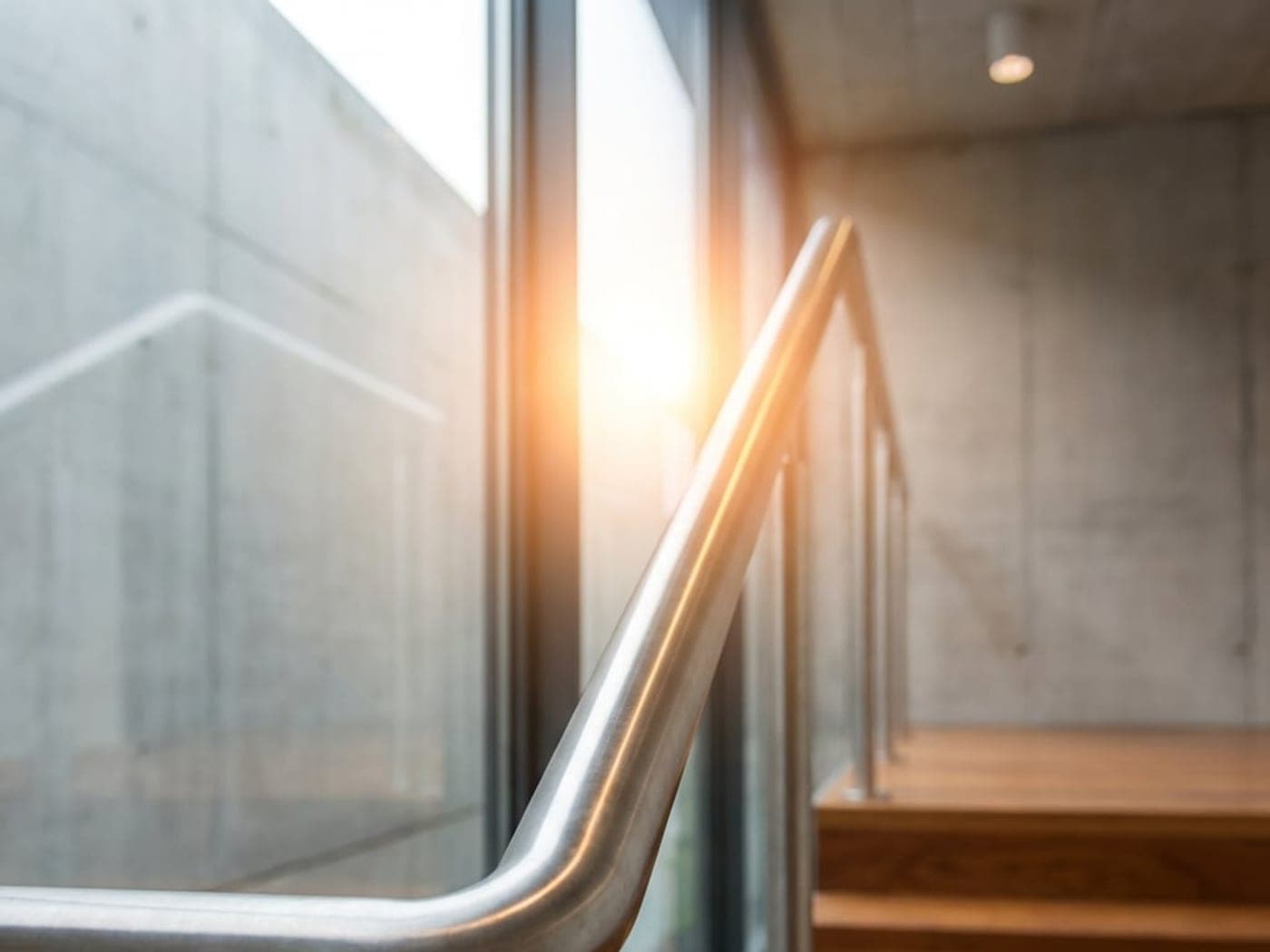
Ten years ago a Riyadh staircase was a steel tube and a row of vertical bars. Today the default on a new villa in Hittin or a tower lobby on King Fahd Road is glass — frameless where the budget allows, semi-frameless where it does not. A 12 mm panel carries the same guard load as a steel infill full of bars, without blocking daylight or trapping dust along thirty edges.
The catch is that glass is unforgiving of shortcuts. It will not hide a bad fixing detail, an unverified interlayer or a channel cast without a drainage path — it cracks or leaks two summers later, once the finishes around it are complete. This article covers systems, glass specification, code loads and costs.
Why Glass Took Over Riyadh Staircases
Plots shrank while built-up area grew, so stairs moved to the centre of the plan and lost their window; a barred guard turns that core into a dark shaft. The villa palette also moved toward stone and large-format porcelain, where heavy steel reads industrial and glass nearly disappears. And a powder-coated railing chalks within four to six summers, every bar an edge to re-coat.
The trade-off is real. Glass costs more per linear metre than a good aluminum railing, shows dust and fingerprints, and in this city needs cleaning every two to three weeks to stay an asset. On a rental unit or a low-cost build, aluminum with a stainless top rail remains the rational choice; glass earns its premium on owner-occupied villas, hotel and office lobbies, and showrooms.
The Four Systems Behind Every Quote
Frameless channel-set. A 12 mm toughened panel sits in a U-profile — stainless, aluminum or a recess cast into the slab — bedded on setting blocks and pointed with structural silicone. Cleanest look, highest cost, least tolerant of movement. It needs a structural slab or a designed steel upstand, never a 50 mm screed.
Standoff or spigot fixed. Panels bolted to the slab edge through stainless standoffs, or held in short base shoes. Cheaper to install and easier to replace one panel, but the fittings show and each penetration is a water path on an external balcony. On a tower, that slab-edge anchor must be engineered, not estimated.
Semi-frameless. Panels clamped at the base with a continuous stainless or aluminum cap rail. The rail stiffens the assembly, settles the graspability requirement without argument, and is the most common specification on Riyadh villa stairs. Full-frame. Aluminum posts at 1.2 to 1.5 m centres: cheapest, most forgiving of substrate, and the only option on a raised curb, timber deck or structure you cannot modify.
Glass Specification: What Goes in the BOQ
Internal stair guards are usually 12 mm thermally toughened soda-lime glass. Extra-clear low-iron matters more than clients expect: standard float has a green edge that reads strongly at 12 mm, while low-iron stays neutral. The premium is 15 to 25 percent on the glass and it is the single change that makes a stair look expensive.
Any guard above or beside a drop should be laminated; on external balconies it must be. The usual build-up is 6.6 plus 6.6 mm toughened with a 0.76 mm PVB interlayer, or better a 1.52 mm ionoplast (SGP) interlayer. PVB holds after breakage but creeps and can delaminate at the edges under sustained heat; SGP is stiffer, keeps the panel in place post-breakage and resists moisture. On a third-floor balcony, specify SGP in writing.
Also write in: polished flat edges rather than arrissed, holes drilled before toughening with at least 8 mm edge cover, heat-soak testing on large panels, a test certificate per panel, and bow of no more than 3 mm per metre. These lines cost nothing to specify and are the first a cheap bidder deletes — which is why comparison should start there.
Wind Loads, Movement and SBC 801
SBC 801 follows the international model: a guard must resist a uniform line load of about 0.75 kN per metre at the top, plus a concentrated load of roughly 0.9 kN in any direction at handrail height. Glass is normally verified additionally to ASTM E2353 or an equivalent impact test, because a static check alone does not tell you what happens when a body hits the panel.
Load rarely fails a balustrade; movement does. Riyadh swings between cool nights and 45 degree days, so an aluminum channel moves several millimetres over a six metre run and a panel gripped rigidly at both ends cracks at a fixing or opens a joint. Use slotted fixings, setting blocks and a continuous silicone bead. On upper floors wind governs — a three metre tower balcony guard must be checked against local gust pressure at that height, not a generic 1.0 kPa.
Trends in Riyadh Villas
Frameless channel guards on the main stair with a matching glass landing panel, so the stair reads as one continuous sheet instead of framed rectangles. A slim cap rail on top — 40 to 50 mm in brushed 316 stainless or black-anodised aluminum, half the mass of the old 60 mm tube — which also settles the graspability argument before it starts.
Edge lighting: a 12 V LED strip inside the channel or under the cap rail, on the stair lighting circuit. It costs SAR 120 to 200 per metre at first fix and is nearly impossible to add later without pulling the guard. Stone or porcelain nosing paired with the glass, and wood-look aluminum cap rails — the warmth of timber with none of the maintenance — are both spreading fast.
Trends in Towers and Balconies
On towers the driver is wind, access and inspection. Balcony guards are moving to laminated glass with SGP, interlocking or overlapping joints instead of open gaps, and a continuous bottom channel that drains to defined outlets rather than sitting in standing water and dust. Ceramic frit dots or a gradient band are specified on high floors for privacy and to cut solar gain, and solar-control coatings on south and west elevations are now routine.
Maintenance access is the detail designed out, then regretted. Four thousand linear metres of glass guard needs a strategy: panels reachable from the balcony, or davits and a rope-access plan. Specify it at design stage. Inside towers, balustrades are moving to point-fixed standoffs with heavy 15 mm glass and no top rail — spectacular, and only defensible with an engineer signing the fixing layout.
What It Costs in Riyadh, and Who to Buy From
Budget figures for 2026, installed in Riyadh: frameless 12 mm channel-set SAR 850 to 1,400 per linear metre; point-fixed or spigot SAR 950 to 1,600; semi-frameless with a stainless cap rail SAR 700 to 1,100; full aluminum post system with 10 mm glass SAR 600 to 950. Glass alone is SAR 180 to 280 per square metre for 12 mm clear toughened and SAR 320 to 480 for 6.6 plus 6.6 low-iron laminated with SGP.
Ramz Al Badran fabricates and installs glass and stainless balustrades from our factory in Riyadh, quoting per linear metre of completed guard with the glass build-up and interlayer named, the channel or fixing system listed separately, edge work and holes included, and engineering in the package rather than a surprise extra. Send the stair or balcony dimensions, the floor build-up at the fixing line and a photograph, and we will return an itemised quotation — and tell you honestly if a simpler aluminum railing would serve for less.