
6 October 2026•5 min read
Car Park Canopies: Alucobond, Glass or Polycarbonate?
Practical guidance from Ramz Al Badran's factory in Riyadh on canopy installation Saudi Arabia — what to specify, what it costs and how it performs in the Saudi climate.
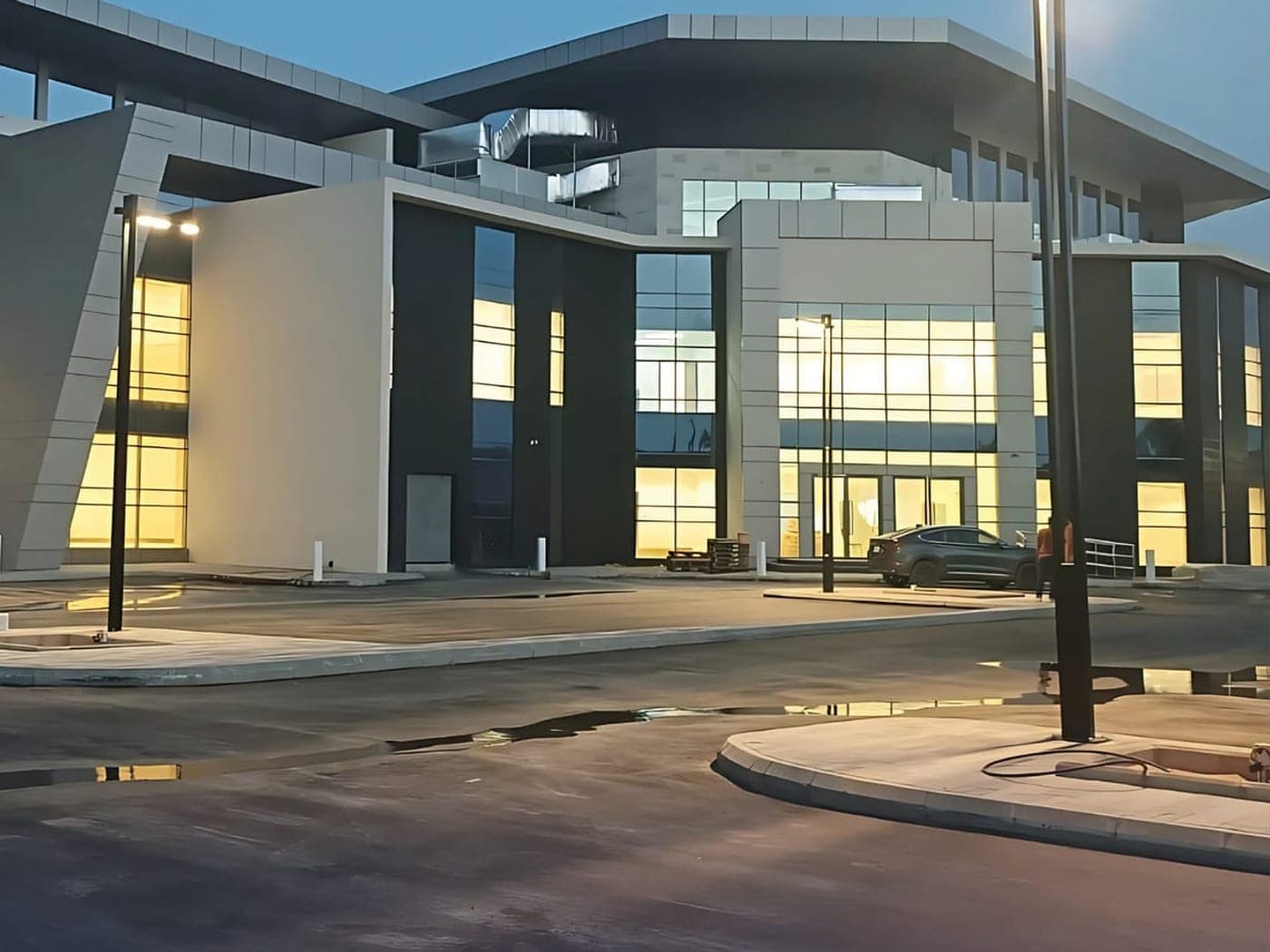
Ask a Riyadh contractor what covers the cars in a new compound and you will usually hear one of three answers: Alucobond panels, laminated glass, or polycarbonate sheet. All three can shade a parking bay, an entrance or a walkway, yet they behave very differently under Saudi sun, wind-borne dust and the occasional hailstorm, and they sit in three very different price bands. This guide compares them on the points that decide satisfaction five years after handover: cost, span, heat, maintenance and building-code compliance.
What the Saudi Climate and Building Code Demand
Three loads dominate the design of any canopy in the Kingdom. Wind is the first: a car park roof is a wide horizontal catching surface, so the uplift calculated under SBC 301 must be engineered into the frame, the columns and their footings rather than guessed on site. Sun and ultraviolet light come second, because coatings and plastics only survive Riyadh summers when the specification names a tested standard instead of a colour code. Dust and hail come third: sand-laden wind abrades faces over time, and Riyadh occasionally receives hail that cracks unprotected sheet.
Two further rules decide how a canopy feels to users. Water must be collected and led to a defined discharge point, since municipal practice does not accept it spilling onto parked cars or across a walkway where it becomes a slip risk. And any canopy over a means of egress, or within a commercial plot, forms part of the life-safety and Civil Defence review, which is why drawings, fixings and glazing type all have to be settled before fabrication.
Alucobond (Aluminium Composite) Canopies
Alucobond is a 4 mm aluminium composite panel: two thin aluminium skins bonded to a core, normally a fire-rated mineral core for external use. It is the only one of the three materials that gives a solid, opaque, architecturally clean fascia, and because the face can be any colour it is often chosen to match or deliberately contrast with a building's aluminium composite cladding. The panel weighs about 5.5 kg per square metre, never rusts, and takes a powder or PVDF coating that holds colour well in strong sun.
One detail separates a good ACM canopy from a noisy, buckled one. Aluminium expands roughly 0.023 mm per metre for every degree of temperature change, so a four-metre panel moves close to 4 mm across a typical day-to-night swing. The fixing system must therefore combine fixed and sliding points and leave expansion gaps, and the panel edges must be sealed with the approved profile. Because ACM is opaque it brings no daylight and can trap heat beneath it, so it suits entrance canopies, fascias and covered walkways better than long rows of parking bays.
Laminated Glass Canopies
Glass is the premium answer and the one with the strictest rules. Anything installed overhead must be laminated safety glass, with two or more plies bonded by a PVB or ionoplast interlayer, so that if a ply breaks the assembly keeps residual load capacity and cannot fall as a single shard. Monolithic toughened glass is not acceptable overhead, whatever the span.
Glass is also the heaviest option at about 30 kg per square metre for a 6+6 mm build-up, so the frame, columns and footings grow with it. It transmits daylight beautifully over a walkway, but it transmits heat and glare too, so tinted, reflective or heat-rejecting interlayers are normal. It shows dust immediately: in Riyadh a glass canopy is typically cleaned every four to eight weeks or it loses the transparency that justified its price, and it is usually reserved for a signature entrance or a short walkway rather than a long parking row.
Polycarbonate Canopies
Polycarbonate is the workhorse of car shade canopies because it is light, tough and inexpensive. Solid sheet weighs about 1.2 kg per square metre for each millimetre of thickness, and multiwall sheet is lighter still, roughly 2.7 kg per square metre for a 16 mm build, so the supporting steel frame can be far lighter than for glass. A quality sheet carries a co-extruded UV layer on one face; that face must be specified and fitted facing the sky.
Properly UV-stabilised polycarbonate does not shatter, and it handles hail far better than glass. The failure to avoid is cheap unstabilised sheet, which yellows and embrittles within a few years and then has to be replaced. Clear sheet passes most daylight, while opal, bronze and grey tints cut heat and glare at the cost of light. Expect around ten to fifteen years of service from a good UV-protected product before re-sheeting.
Cost, Span and Maintenance Compared
As 2026 planning figures for Riyadh, supplied and installed: a polycarbonate-roofed car park canopy usually falls around 400 to 700 SAR per square metre of covered area; an Alucobond canopy around 550 to 900; and a laminated glass canopy around 1,300 to 2,500. Glass sits at the top mainly because of its weight and the heavier structure it demands beneath. These are ranges, not quotations.
Span shapes the choice. Polycarbonate and Alucobond cross the five to six metres between parking rows with modest sections, while glass prefers shorter bays and deeper framing. Maintenance is the quiet cost owners forget: polycarbonate needs re-sheeting once in its life, glass needs a regular cleaning cycle, and ACM mostly needs an occasional wash. Footing conditions, height, colour and Civil Defence documentation move the final number more than the roof material alone.
Which Material for Which Canopy
The practical mapping is simple. Polycarbonate for long rows of parking bays and shaded walkways, where cost and impact resistance matter most. Alucobond for entrances, fascias and canopies that must match a building's cladding and read as solid architecture. Laminated glass for a signature entrance or a short walkway where daylight and a premium appearance justify the cost.
Whatever the material, insist on the same short checklist: a wind-engineered steel or aluminium frame with genuine uplift fixings into engineered footings; drainage to a defined discharge point; powder coating to AAMA 2604 or equivalent on metal; UV-protected sheet for polycarbonate; laminated safety glass for any overhead glazing; and a written warranty that names the coating and the sheet, not just the canopy.
How Ramz Al Badran Helps
Ramz Al Badran fabricates car park, entrance and walkway canopies from our own factory in Riyadh, and we work daily in aluminium composite cladding, where the same panel systems that clad a building are shaped into its canopy. Because we build the frame, the roof and the cladding under one roof, we can match an Alucobond fascia to your facade, detail a polycarbonate car shade canopy that survives Riyadh summers, or engineer a laminated glass canopy for an entrance, and deliver it alongside our pergolas with consistent detailing across the whole site. Every quotation is itemised, with the coating, glazing and sheet specification named and the wind and drainage detailing spelled out. Send us your plans and elevations and we will advise which of the three materials suits each canopy.