
12 September 2026•5 min read
Aluminum vs Steel Canopies for Commercial Buildings
Practical guidance from Ramz Al Badran's factory in Riyadh on canopy installation Saudi Arabia — what to specify, what it costs and how it performs in the Saudi climate.
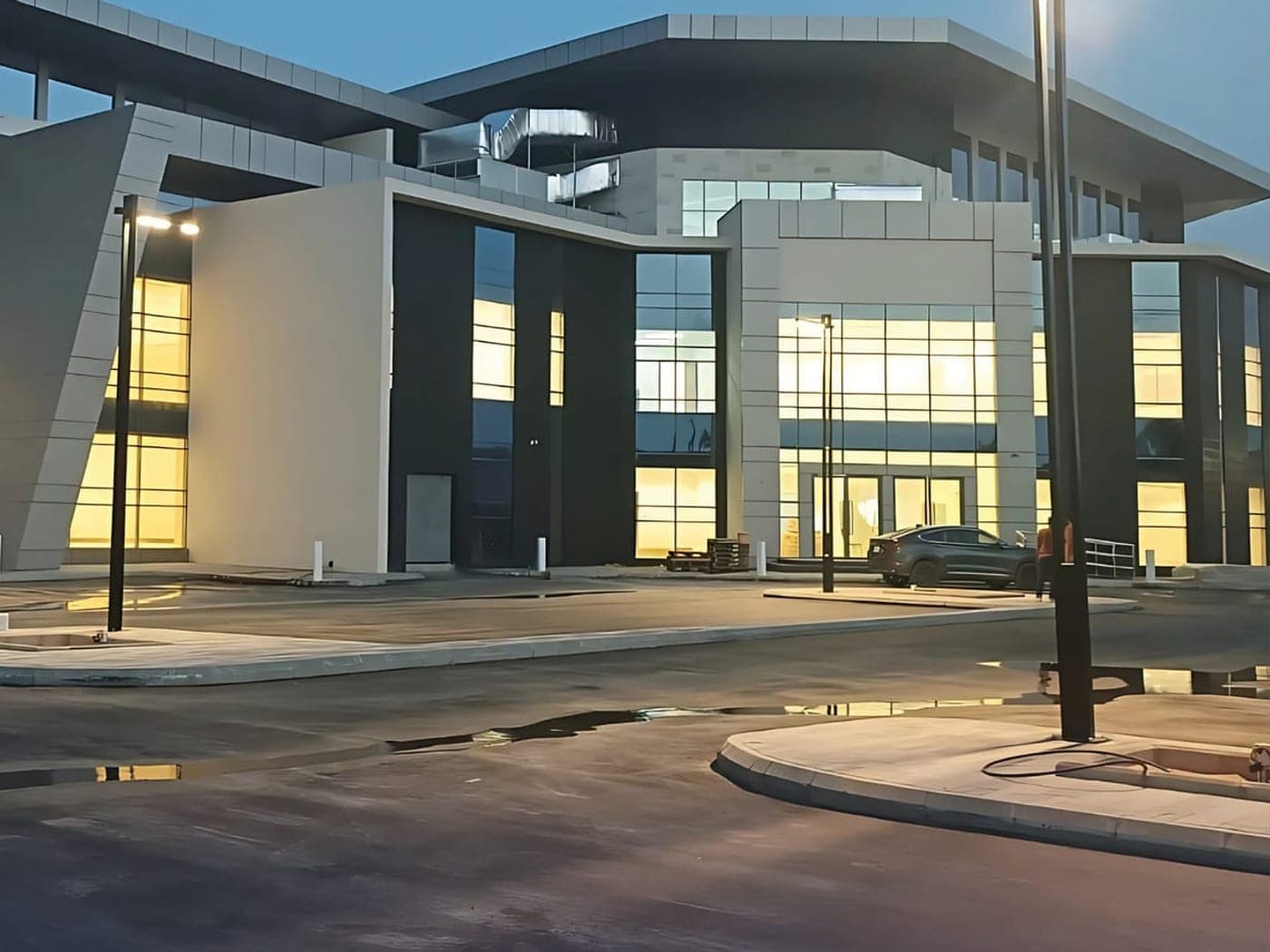
Nearly every commercial building in Saudi Arabia wears at least one canopy — over the entrance, across a walkway, or spanning a row of parking bays. It is a small structure carrying serious loads: it intercepts the sun before it reaches glazing and pedestrians, sheds the sudden cloudbursts that Riyadh gets several times a year, and resists the uplift that wind applies to any horizontal plane. The first decision that shapes how well it does all of that is the material — aluminum or steel. The comparison below reflects what Ramz Al Badran's fabrication floor in Riyadh handles week after week.
What the Saudi Climate and Building Code Demand
Saudi Building Code SBC 601 treats a building-attached canopy as part of the envelope, so it must be engineered for the site wind pressures — in Riyadh that means genuine uplift on wide, flat canopies rather than a nominal allowance. Three environmental loads then decide the detailing: intense UV that degrades cheap coatings within a season or two, large day-night temperature swings that make aluminum move roughly twice as much as steel, and humidity that attacks bare steel edges first in coastal cities. A specification that ignores any one of these will fail long before the material itself does. Local municipal practice also requires canopies to drain to a defined point rather than spill onto walkways, so roof geometry has to be settled at the design stage, not improvised on site.
Aluminum Canopies: Light, Precise and Corrosion-Free
Aluminum canopies are built from extruded 6063-T5 or T6 profiles, fabricated into rafters and purlins and finished with powder coating. Because aluminum does not rust, a well-coated entrance canopy in Riyadh keeps its colour and its crisp sightlines for decades without a repaint cycle — the main reason aluminum dominates commercial entrances in the city. The members are light enough to be handled and positioned by hand, which keeps installation simple on occupied buildings where crane access is tight.
The limit is span. Standard extruded sections work economically to about six to eight metres, after which profiles deepen and the price climbs steeply. For wide car shade canopies, aluminum performs best over intermediate columns or with cable bracing rather than oversized members. Specify powder coating to AAMA 2604: under Saudi UV it holds colour and resists chalking far longer than standard polyester, and that single line in the specification is the difference between a canopy that still looks new at year ten and one that looks tired at year three.
Steel Canopies: Long Spans and the Corrosion Tax
Structural steel — typically S275 hollow sections — carries clear spans of ten metres and more with comparatively shallow members, which is why wide parking structures and long covered walkways default to steel. Welded frames and trusses handle cantilevers that aluminum would need a column to support. The trade-offs are weight and corrosion: steel demands heavier foundations and usually a crane on site, both of which are easy to underestimate at the budgeting stage.
Corrosion is the operating cost that settles the lifetime comparison. Hot-dip galvanized steel with a paint or powder topcoat performs well inland, but every cut edge, weld and bolt hole is a path for moisture, and in coastal Saudi cities rust shows within a year on unprotected details. Budget for repainting steel every three to five years in harsh exposures; spread across a decade, that recurring cost frequently overtakes the material saving made at purchase.
Comparing Installed Cost in Riyadh (2026)
Working 2026 ranges from Riyadh fabricators: hot-dip galvanized steel with a paint finish lands around SAR 350–550 per square metre installed, while aluminum with AAMA 2604 powder coating runs SAR 450–700 per square metre. Feature entrance canopies with aluminum composite cladding or glass inserts push both materials higher, as do long steel spans using heavy sections. For a typical 40–60 square metre entrance canopy, expect SAR 25,000–45,000 installed in either material. The point worth remembering is that the gap between aluminum and steel is usually smaller than the gap between a detailed specification and a vague one — anchor type, coating system and drainage detailing move the price far more than the base metal does.
Matching the Material to the Application
Entrance canopy projects in Riyadh usually choose aluminum: crisp sightlines, integration with aluminum doors and cladding, and no repainting make it the value choice for a structure the client sees at eye level every day. For car shade canopies the driving factors are span and wind: wide clear areas over parking rows favour steel portals, or aluminum frames on intermediate columns, and the roof sheeting must be fixed through the purlin into the structure so storm uplift cannot peel it away.
Walkway canopies sit between the two: long runs of repeated bays suit steel economy, while short covered links between buildings suit aluminum lightness, especially where the canopy cantilevers off an existing wall. Whatever the application, drainage is the detail people regret skipping — flat canopy roofs in Riyadh trap dust and sand, so specify a minimum slope, cleanable gutters and downpipes, and overflow scuppers sized for a sudden downpour.
Anchoring, Drainage and Installation Sequence
Canopy installation in Saudi Arabia is a structural trade, and the anchor schedule is its heart. Fixings into concrete or steel must be engineered for gravity and uplift together — expansion or chemical anchors, cast-in plates, or through-bolts — with the calculation on file wherever the municipality requests a stamped structural design. On retrofits, verify the roof membrane and slab condition before drilling; most post-installation leaks trace back to a fixing that punctured the membrane, not to the canopy itself.
Sequence matters as much as design. Erect and level the frame before any cladding goes on, torque structural bolts to the schedule rather than by feel, and flash and seal every penetration into the building. A fabricator who supplies a drawing package covering anchor types, torque values and waterproofing details gives you the documentation you need when a contractor has moved on and a leak appears later.
Fabricated in Riyadh with Ramz Al Badran
Ramz Al Badran's factory in Riyadh designs and fabricates both aluminum and steel canopies under one roof — entrance canopies, car shade structures and walkway covers — with in-house structural detailing, powder coating to AAMA 2604 and a documented anchor and quality schedule. Because we fabricate rather than subcontract, the itemized quotation matches the actual profiles, finish and fixings, and the engineering is carried out for Saudi wind loads from the first drawing.
Send us your drawings or a simple sketch — span, location, roof finish and whether it is new construction or a retrofit — and we will return a specification and a fixed price for canopy installation in Saudi Arabia. You are welcome to visit the factory in Riyadh, inspect the coating line and the profile systems, and walk through completed entrance and car park canopies before you commit.